

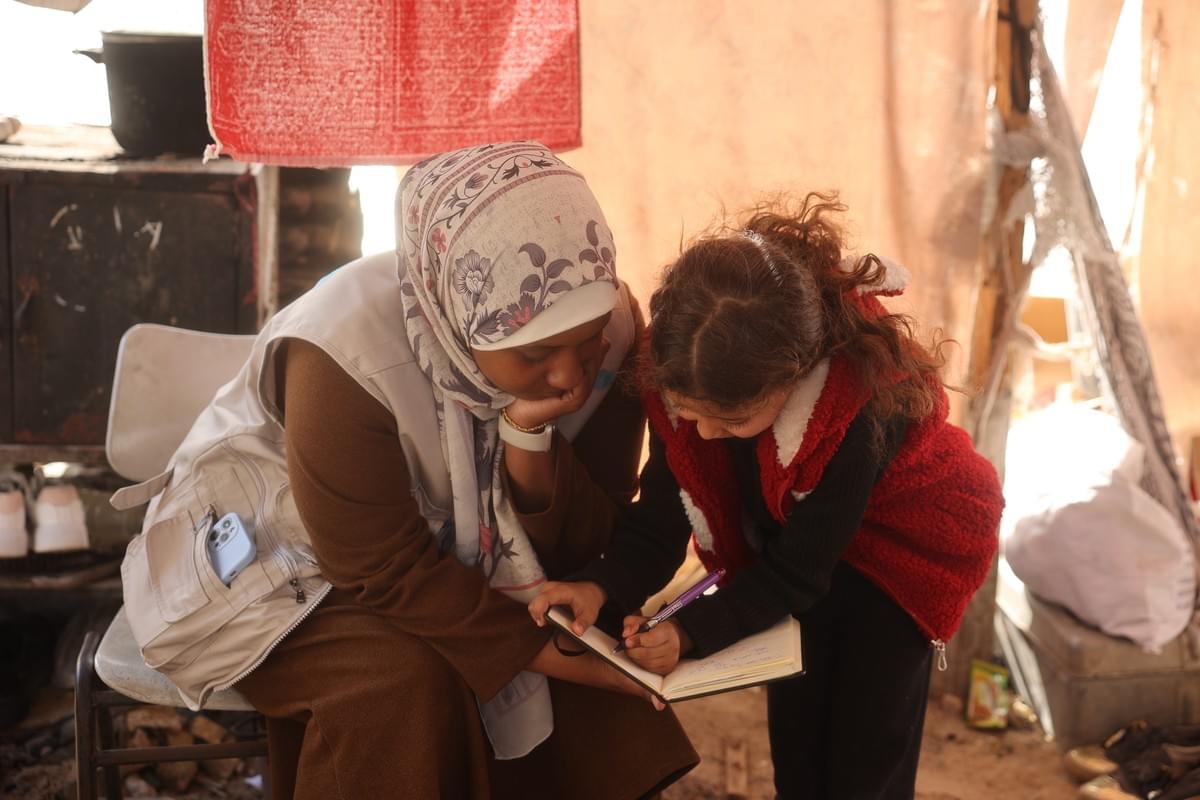
Picture a caseworker in Gaza. Their office has no power. Their phone has one bar of signal, if they are lucky. They are holding a case file for a child who has already been displaced twice this year, and they need to know, right now, whether another organization is already supporting that same child, or whether this file is the only lifeline the child has.
A year ago, the honest answer might have been: They couldn't know. The record could have been sitting in a paper folder, in a spreadsheet on someone else's laptop, or nowhere at all.
Today, they can check in seconds. That small change may not sound revolutionary. In Gaza and the West Bank, it can mean the difference between a child receiving timely support and a child slipping through the cracks.
The rollout of CPIMS+/Primero is one of the most consequential humanitarian information management stories in Palestine over the past year, not because the technology itself is extraordinary, but because it succeeded in a context where almost every condition for success was missing. Power cuts. Displacement. Staff turnover. Connectivity failures. And yet somehow, it worked.
How did dozens of organizations agree on a system to protect and manage child protection information during a war? And why, despite the progress, does one seemingly simple piece of equipment still threaten to slow everything down?
© UNICEF/UNI739234/El Baba
Governance first, software second
The rollout didn't start with installing software. It started with trust. As a case worker put it:
"Explaining how the system protects the child's information helped us gain the caregiver's trust and consent. For us, Primero represents a major improvement from paper-based documentation."
From April 2025, the Child Protection Area of Responsibility led a structured consultation process with national organizations, international NGOs, UN agencies, and the national stakeholders to figure out whether a shared system could actually work and what would need to be true for partners to trust it with children's most sensitive information.
That process produced Standard Operating Procedures for Case Management and the Inter-Agency Data Protection and Information Sharing Protocol, governing how child protection data could be collected, stored, shared, retained, and destroyed. Endorsing it became mandatory for any agency joining the interagency effort, meaning the data protection backbone was in place before the system went live. That sequencing, governance, then technology, is arguably the single clearest lesson from Palestine's experience, and it's the opposite of how a lot of digital transformation projects actually unfold.
The question, of course, is whether all this preparation translated into real-world adoption. By mid-2026, the numbers suggested it had.
What it actually changed for the people doing the work
But policies and protocols only matter if they make life easier for the people using them.
The real test of CPIMS+/Primero wasn't whether partners endorsed it or whether agencies agreed on common procedures. It was whether a caseworker, managing dozens of vulnerable children in one of the world's most challenging humanitarian environments, could do their job better because of it.
By most accounts, that is exactly what happened.
For supervisors, one of the most immediate changes was visibility: they could monitor case progress remotely and provide guidance in real time.
"As supervisors, we have seen a significant improvement in caseworkers' professional performance. The system helps them organize their cases, plan their interventions, and work with greater confidence."
For case workers themselves, the benefits were often more practical than technological. Case information could be updated as situations evolved, referrals could be tracked, and follow-up actions were less likely to be missed during periods of displacement or disruption.
Perhaps the most significant change came in coordination between organizations. In an emergency where needs far exceed available resources, knowing who is already providing support can make the difference between duplication and coverage.
"When we know that one organization is already supporting a child, another organization can focus on a different child. This helps services reach more people and gives everyone a fairer opportunity to receive support."
One case illustrates what this looked like in practice. A child's school identified a health-related issue that was affecting attendance. The family could not afford an assessment. Using CPIMS+/Primero, a caseworker documented the concern, arranged referrals, recorded follow-up actions, and kept the case under review while a supervisor monitored progress remotely. The case remained open until support had been delivered and its outcome verified.
As the caseworker explained:
"The system reduced the burden of documentation and made it much easier to follow cases. When a child's situation changed, we could update the assessment and respond to the new level of risk."
Individually, these improvements may seem modest. Collectively, they changed how child protection services were coordinated, supervised, and delivered across the response.
The numbers, at a glance
Stories from caseworkers help explain why the system matters. The data shows how far its reach has grown.
By July 2026, more than 12,340 total case records with 4,613 open records had been managed through CPIMS+/Primero, demonstrating adoption at a scale that would have been difficult to coordinate through paper-based systems alone. The rollout also reached 31 registered organizations and 320+ trained active users.
Who are the children behind these numbers? Almost half are aged 6–11, with children aged 12–17 making up roughly a third of the caseload. Psychosocial distress is the single most frequently recorded concern, at 57% of all documented protection issues, followed by neglect and psychological violence. Gaza accounts for approximately 83% of all location-identified concerns. A number that, more than any other, captures where the need is most acute right now.
Not every trend is reassuring, and that's arguably the healthiest sign of all: 15.4% of cases remain unclassified by risk level, a gap the coordination team has already flagged as a priority for the second half of 2026.
Doing this during blackouts, displacement, and staff turnover
The remarkable thing isn't that the system was deployed. The remarkable thing is where it was deployed. Partners were contending with power cuts, patchy connectivity, and constant staff turnover that would derail most digital projects outright.
Instead, teams adapted around them. In Gaza, some caseworkers batch-entered multiple cases during the rare windows when laptops and connectivity aligned; others updated records from personal phones whenever field conditions allowed. When funding gaps forced staffing changes, the coordination team worked with affected organizations to deactivate old users and create new user accounts and keep high-risk cases from falling through the cracks rather than being abandoned mid-follow-up. This came with ongoing training and training of trainers to allow agencies to independently train new staff members.
None of these were elegant solutions. They were the kind of practical, sometimes improvised adaptations that keep a system alive in a context most software was never designed for.
The one problem software couldn't solve
For all this progress, one obstacle has proven stubbornly hard to solve and it isn't a software problem at all. It's hardware.
CPIMS+/Primero was built to work offline and on mobile devices precisely because partners anticipated connectivity gaps. What's harder to work around is a shortage of the laptops and tablets caseworkers need for sustained, detailed case work rather than quick updates squeezed onto a phone screen.
In Gaza specifically, this isn't just a budget problem: bringing laptops in requires navigating access and import constraints far beyond normal procurement. Some organizations have too few working devices for their caseload, forcing teams to schedule shared device time or wait for the rare office day when a laptop is free.
Partners have adapted, as they've had to with everything else. But these are workarounds, not fixes. Closing this gap will take sustained advocacy and dedicated resources to facilitate the entry of laptops into Gaza, treating equipment access as seriously as access to humanitarian support and services.
© UNICEF/UNI739234/El Baba
The takeaway for anyone building systems in a crisis
Lessons from Palestine serves for any country or context trying to introduce shared systems in a difficult environment:
- Start with trust, not tools. The data protection agreement came before the software rollout, not after and it's what made partners willing to share sensitive information at all.
- Ownership beats imposition. The system was shaped through months of consultation with the people who'd actually use it, rather than delivered as a finished product from outside.
- Training has to bend to reality. Combining live sessions, recorded materials, and ongoing remote support was what let training reach people despite constant access and connectivity barriers.
- Data should trigger action, not just reporting. 15.4% of unclassified cases aren’t buried in an appendix, it's being used right now to plan the next phase of work.
- Software is only as good as the hardware underneath it. No clever offline functionality replaces having a working laptop in hand which is why device and internet access remain an advocacy priority, not a solved problem.
Which brings us back to the caseworker holding a file for a child who has already been displaced twice. A year ago, finding out whether another organization was already helping that child could take hours, days, or never happen at all. Today, in most cases, the answer is only a few clicks away.
That may not sound like a technological breakthrough. In a humanitarian emergency, it can be the difference between duplication and coordination, between delay and response, between a child being overlooked and a child receiving support.
Palestine's experience with CPIMS+/Primero is not a story about software. It is a story about trust, cooperation, and persistence under conditions that would have stopped many initiatives before they began. Technology mattered. But the people who kept it working mattered even more.